Thirteen drivers and dual conduction at the top of the collaborative IEM range
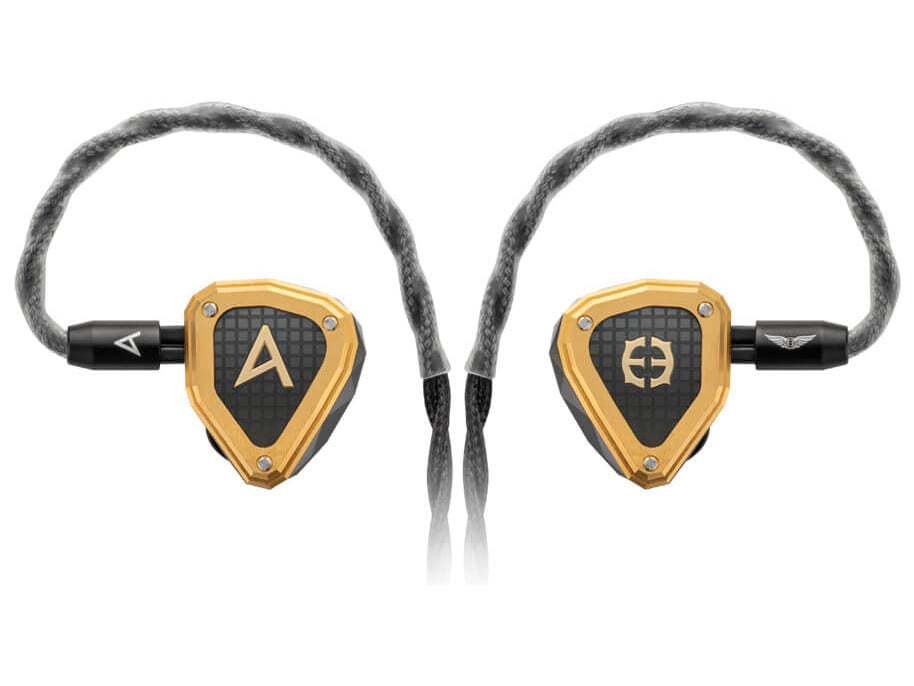
Astell&Kern Novus was created with Empire Ears and combines thirteen transducers per side in a quadbrid architecture using both air and bone conduction.
It is the most complex model in Lot C by driver count and technology. Two W9+ dynamic subwoofers operate alongside five balanced armatures, four electrostatic tweeters and two bone conductors, all coordinated by a multi-point synX crossover. The design is intended to combine extension, low-frequency authority and an unusually expansive spatial presentation.
Key features
- 13-driver quadbrid architecture with Dual Conduction.
- 2 W9+ dynamic drivers dedicated to low frequencies.
- 5 balanced armatures, including four proprietary NOVA drivers.
- 4 Sonion electrostatic tweeters.
- 2 high-mass Sonion bone conductors.
- Specified frequency response from 5 Hz to 100 kHz.
- 2-ohm impedance at 1 kHz and 108.1 dB sensitivity at 1 kHz/1 mW.
- 4.4 mm hybrid copper, gold and silver cable.
Four transducer technologies in one IEM
The low end is handled by the pair of W9+ drivers, while balanced armatures and electrostatics cover the mid and upper ranges. Two bone conductors add a second vibration path alongside conventional air conduction. The synX crossover divides the signal among these sections to maintain coherence between very different driver types.
A load that places particular demands on the source
The nominal 2-ohm impedance calls for careful source matching. A player or amplifier with very low output impedance and fine volume control is preferable, especially because high sensitivity can make residual noise from electronics not optimised for IEM use easier to hear.
Compared with Stella, XIO and Luna
Novus combines the largest number of driver technologies in this group. Stella uses a different 12-driver system developed with VOLK Audio, XIO employs ten drivers together with 64 Audio proprietary technologies, while Luna takes the opposite approach with a single planar transducer. Novus is therefore aimed at listeners seeking the most elaborate multi-driver architecture in the range, particularly when source matching and ultra-low output impedance can be controlled carefully.