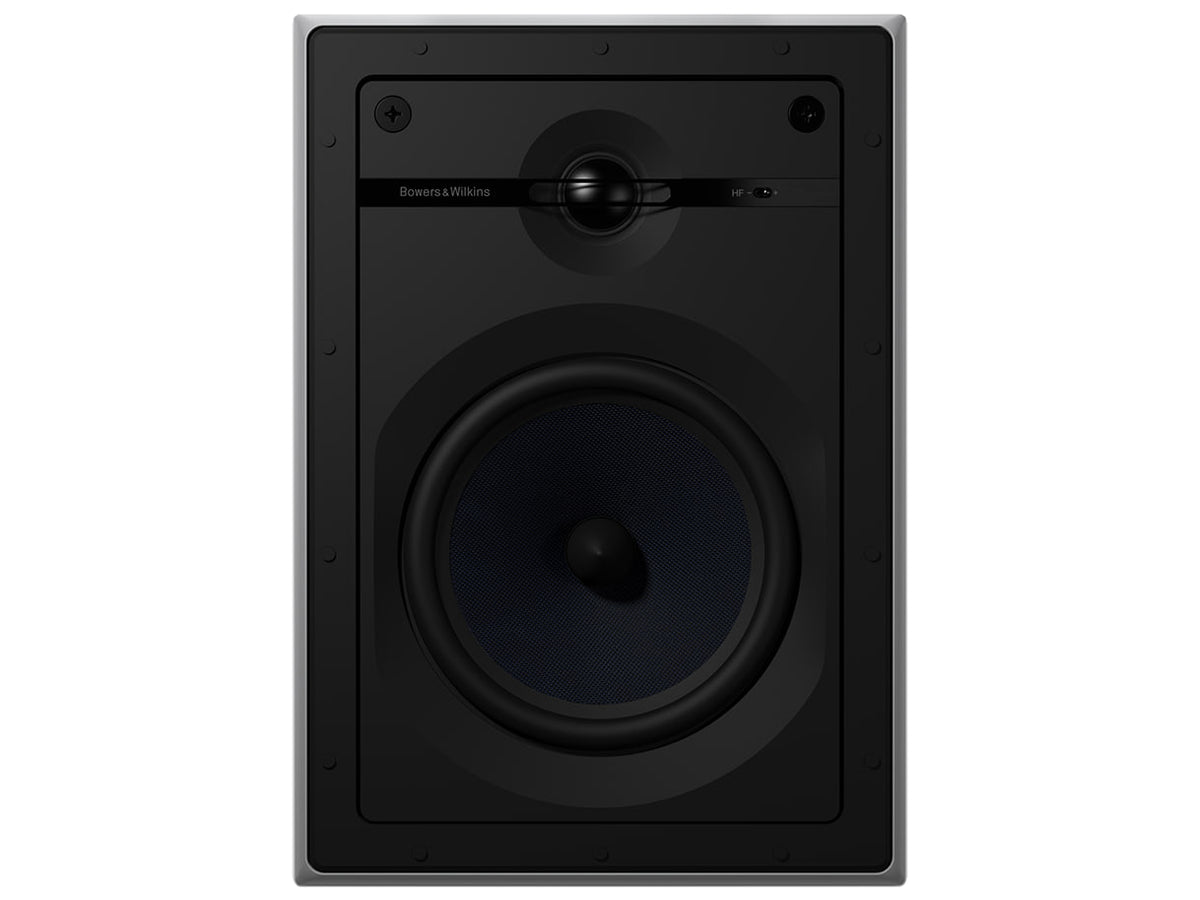
A larger driver within the wall
CWM663 moves to a 150 mm Aramid Fibre cone and Nautilus tweeter.
The Bowers & Wilkins CWM663 pair requires two 279 × 183 mm wall cut-outs. Each frame measures 315 × 221 mm, with 95 mm behind the panel and 4 mm front projection. Its dimensions match CWM664, so driver choices and adjustment options matter more than the size of the opening when selecting between them.
Key features
- Cut-out 279 × 183 mm; frame 315 × 221 mm; depth 95 mm.
- 150 mm Aramid Fibre bass/midrange and 25 mm Nautilus aluminium tweeter.
- 8-ohm impedance (4.5-ohm minimum); 25–150 W specified power.
- Three-position HF switch; QuickDogs; PMK W6.
The CWM663 components
A 150 mm Aramid Fibre driver sits in a die-cast chassis. The 25 mm Nautilus aluminium-dome tweeter works with a three-position high-frequency switch. Compared with CWM652, the driver increases from 130 to 150 mm, the upper stated power rises from 100 to 150 W, and both cut-out dimensions grow.
Figures for matching and fitting
Nominal impedance is 8 ohms with a 4.5-ohm minimum; sensitivity is 88 dB and the -6 dB range 45 Hz to 50 kHz. Specified amplifier power is 25 to 150 W. QuickDogs secure the speaker after cutting, and the connection is designed for convenient fitting. PMK W6 and BB 6W complete the preparation to check against the wall structure and depth.
Sensitivity is 2 dB higher than CWM652. The larger cone, higher power figure and taller opening distinguish CWM663 where the wall can accommodate more radiating area. The 4.5-ohm impedance minimum stays the same, however: when assigning several channels to an amplifier, account for the actual minimum load as well as the nominal figure. The HF switch can be set after the room is furnished. Keep both grilles aligned with the wall finish.