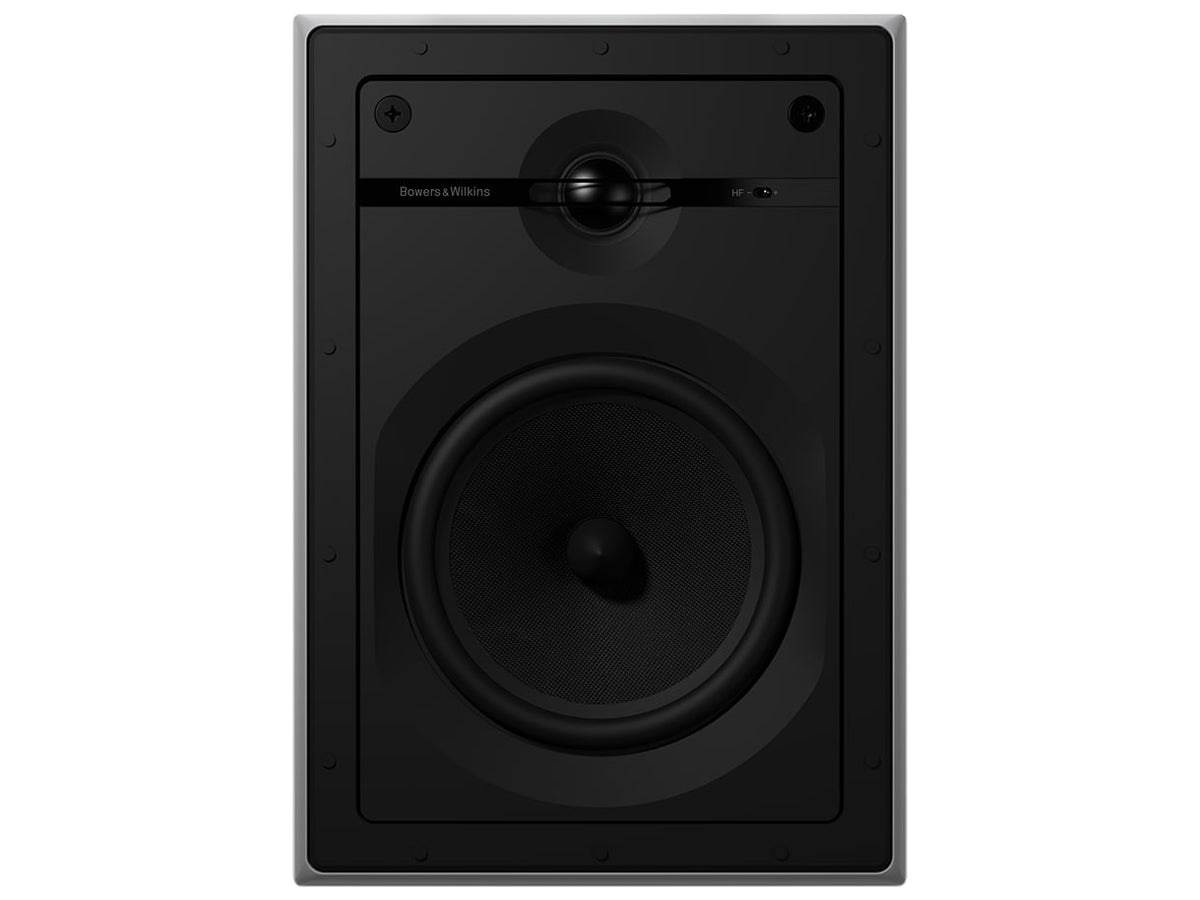
A different sound from the same opening
CWM664 uses glass fibre and a soft dome in CWM663-sized cut-outs.
The Bowers & Wilkins CWM664 pair occupies 279 × 183 mm rectangular openings. Each frame is 315 × 221 mm, with 95 mm behind the surface and 4 mm visible protrusion. Those dimensions match CWM663: where openings are already planned, acoustic configuration and amplifier rating are the deciding factors.
Key features
- Cut-out 279 × 183 mm; frame 315 × 221 mm; depth 95 mm.
- 150 mm glass-fibre bass/midrange and 25 mm soft-dome tweeter.
- 8-ohm impedance (4.5-ohm minimum); 25–130 W specified power.
- Three-position HF switch; QuickDogs; PMK W6.
Materials and control
The 150 mm bass/midrange driver has a woven glass-fibre cone, while the 25 mm tweeter is a soft dome. A three-position switch adjusts treble. CWM663 instead uses Aramid Fibre and Nautilus aluminium, with a 150 W upper figure against 130 W here. QuickDogs simplify fixing to the panel.
Precise preparation
Specified amplifier power is 25 to 130 W, sensitivity 87.5 dB and nominal impedance 8 ohms with a 4.5-ohm minimum. The -6 dB range is 45 Hz to 35 kHz. PMK W6 and BB 6W are listed for fitting. Before cutting, check the alignment of both speakers, stud positions and cable route; the treble control can then be adjusted to suit the finished room.
At 87.5 dB, sensitivity falls between CWM652's 86 dB and CWM663's 88 dB. This matters when balancing several channels that use different drivers. The 279 × 183 mm cut-out must be planned alongside the 315 × 221 mm frame, which may meet trim, architectural details or a screen. Leave the high-frequency selector accessible for final adjustment after the wall is complete. Check the 95 mm rear clearance behind both speakers, too. The frame must also remain clear of any wall trim.