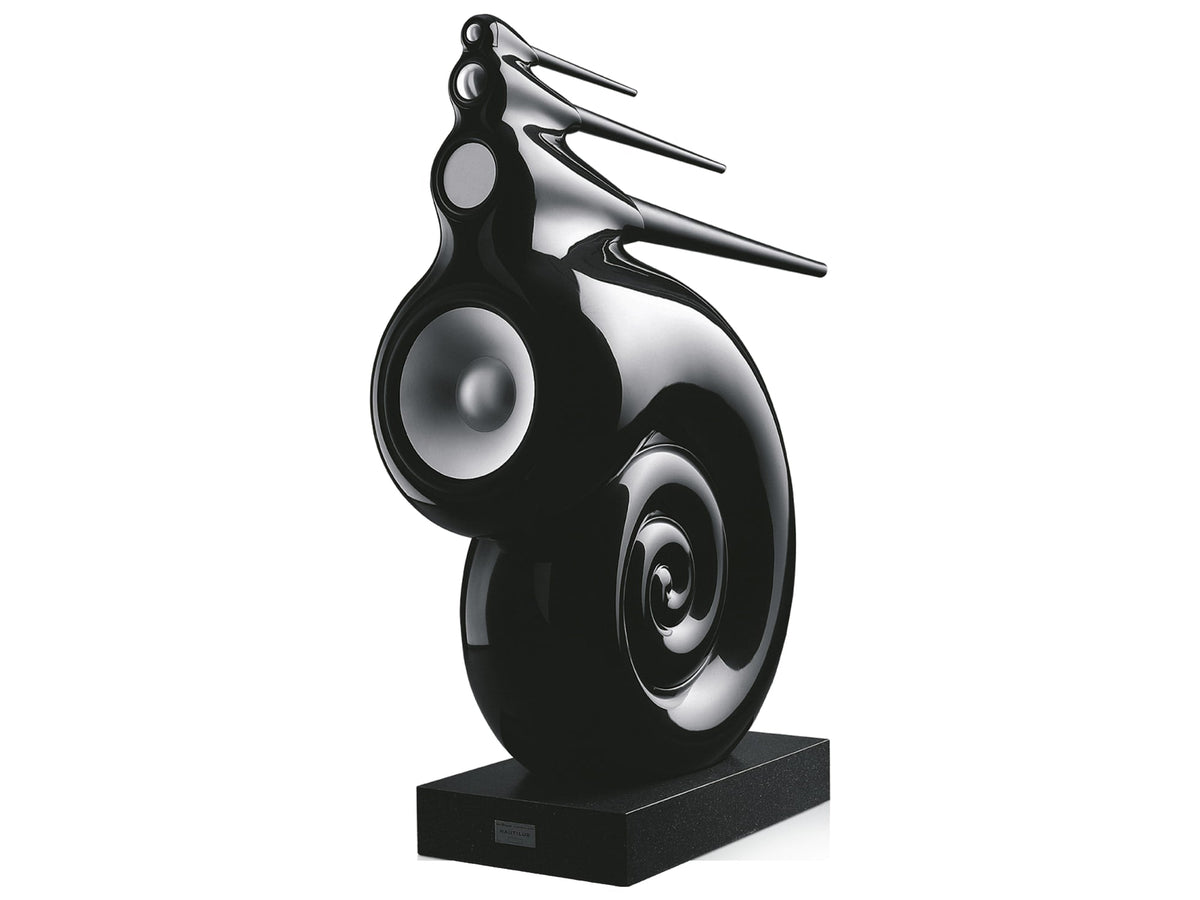
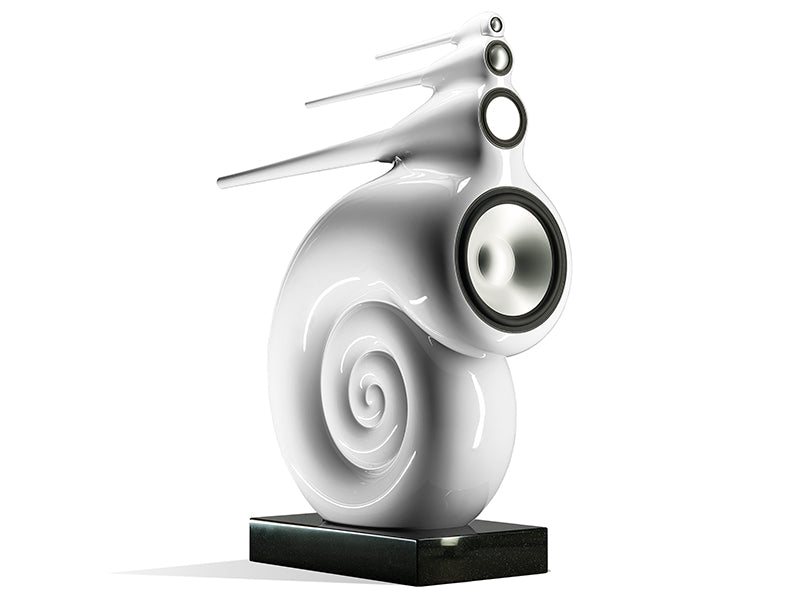
Four ways and an active crossover make Nautilus a complete system to plan.
Its spiral outline follows the long tapered tubes behind the drivers.
The pair of Bowers & Wilkins Nautilus speakers comprises two four-way enclosures, each with a dedicated active crossover. Tubes behind the drivers absorb energy radiated backwards; the shape is part of the acoustic design. Built at Worthing, Nautilus calls for a particular amplification and wiring arrangement to be settled before positioning in the room.
Key features
- Four-way tapered-tube loading and dedicated active crossover
- Drivers: 300 mm bass cone, 100 mm lower midrange, 50 mm upper-midrange dome, 25 mm tweeter
- Four amplifier channels per speaker, each rated 100-300 W continuous into 8 ohms
- RCA or XLR to the crossover; eight power channels for a stereo pair
- Dimensions 1210 × 430 × 1105 mm; 86.5 kg per speaker with plinth
Four separate bands
A 300 mm aluminium cone handles bass, while a 100 mm aluminium/polymer sandwich driver covers lower midrange. A 50 mm dome takes upper midrange and a 25 mm dome covers treble. The active crossover divides these bands ahead of power amplification. Each enclosure needs four distinct amplifier channels, eight for the pair; channel gain and phase should match.
Following the signal
The preamplifier feeds the dedicated crossovers through RCA or XLR connections. Each crossover sends its LF, LMF, UMF and HF outputs to corresponding power channels, which drive the individual units. The crossover does not replace the power amplifiers. The brochure specifies 100-300 W continuous into 8 ohms per channel on unclipped programme. This is unlike connecting ordinary passive speakers to a stereo integrated amplifier.
Weight, depth and placement
Each speaker is 1210 × 430 × 1105 mm and weighs 86.5 kg with its plinth: 44.5 kg for the body and 42 kg for the base. The depth exceeding a metre includes the rear tubes, so check the installation location, cable routes and supporting floor. The manual discusses experimenting with toe-in towards the listening position in relation to the side walls.
Nautilus sits outside the 700 S3 range. Its external crossover, four ways and one amplifier channel per driver define a separate system. The brochure gives a frequency range of 10 Hz to 25 kHz at -6 dB; that tolerance is not equivalent to another speaker's ±3 dB response. Electronics, available space and installation need to be considered together, as does placement of the stereo pair. The active crossovers have their own mains supply and should be accommodated with the amplifiers as part of the complete installation.