When a universal player becomes a pure digital transport
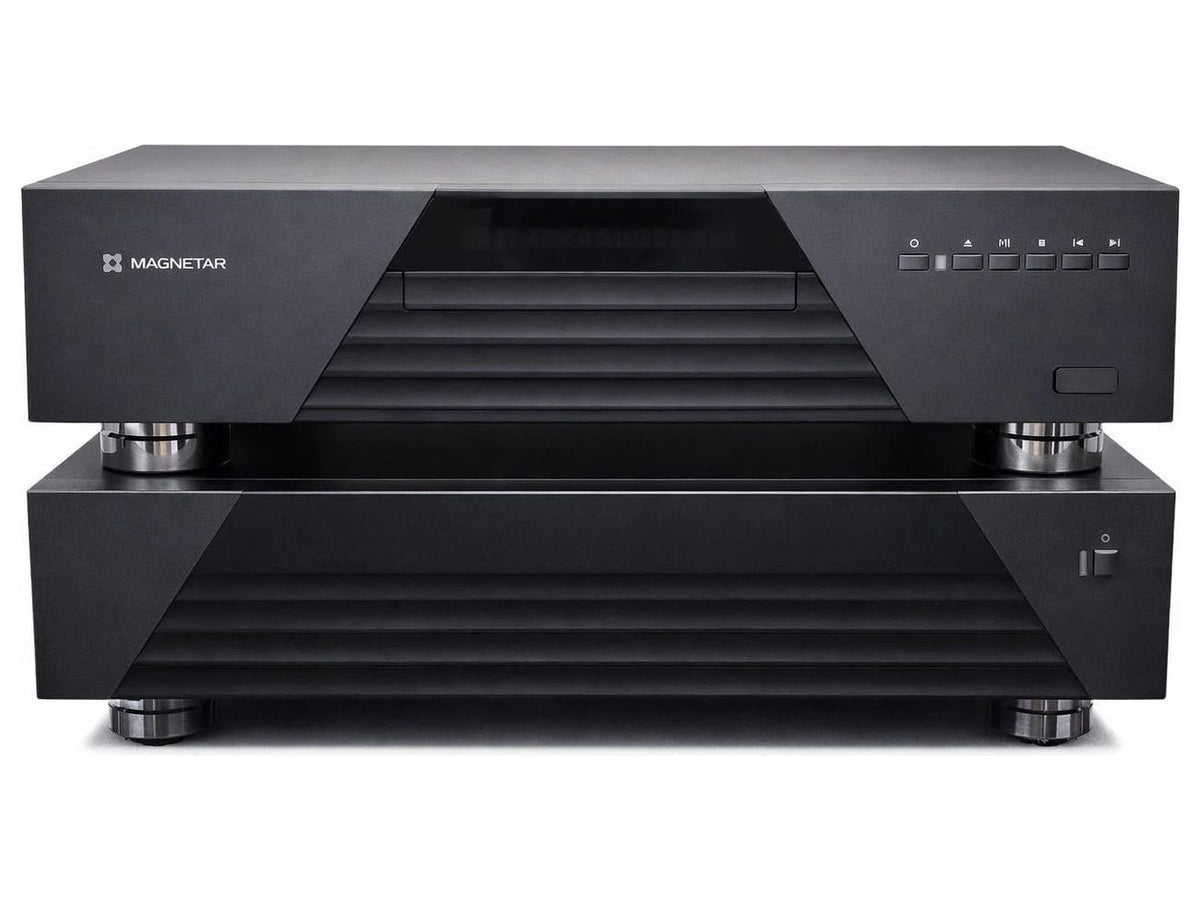
Magnetar ULTIMA reads UHD Blu-ray, Blu-ray, SACD, DVD-Audio and CD but removes the internal DAC entirely, handing the signal to external processors and converters.
It takes a fundamentally different approach from UDP-800 MKII and UDP-900 MKII. There are no analogue outputs and no onboard conversion stage to optimise: the design concentrates on disc reading, power stability, timing accuracy and digital transmission. That is why ULTIMA uses two chassis, lithium battery-assisted power and a synchronised 10 MHz master-clock reference.
Key features
- Pure universal digital transport with no DAC or analogue audio outputs.
- Supports UHD Blu-ray, Blu-ray, DVD, CD, SACD and DVD-Audio.
- Compatible with Dolby Vision, HDR10+, DSD and DoP.
- Two-chassis architecture with a separate power-supply enclosure.
- Lithium battery-assisted power stages.
- Synchronised internal 10 MHz master clock.
- Main and audio-only HDMI outputs, AES/EBU and coaxial digital output.
- USB, Gigabit network, RS-232C and connection for an external 10 MHz clock.
Two chassis separate transport from power
The lower enclosure houses the power stage, while the upper chassis contains the disc mechanism, processing and digital circuitry. The system uses paired battery sections so that critical circuits can run from stored DC power while charging is managed separately. The aim is to keep the transport as isolated as possible from mains variation and electrical noise.
A 10 MHz clock as the common timing reference
ULTIMA uses a 10 MHz master reference from which the frequencies required by its internal subsystems are derived, including 25 and 27 MHz domains. The principle is to reduce timing differences between sections and maintain a more coherent digital stream. A BNC connection is also provided for systems built around an external master clock.
The right system for ULTIMA
It is intended for systems where the downstream DAC, AV processor or digital electronics are already of a very high standard and the source has one job: read and transfer data without analogue conversion. Compared with UDP-900 MKII it deliberately gives up ESS9038PRO conversion, 7.1 analogue outputs and XLR; instead, cost and complexity are concentrated on mechanics, power, isolation and clocking. It makes most sense for substantial physical-media collections used in reference digital systems, where conversion and processing are already entrusted to dedicated external components and the transport is expected to remain strictly digital.