5 amps for a substantial integrated amplifier plus a separate source
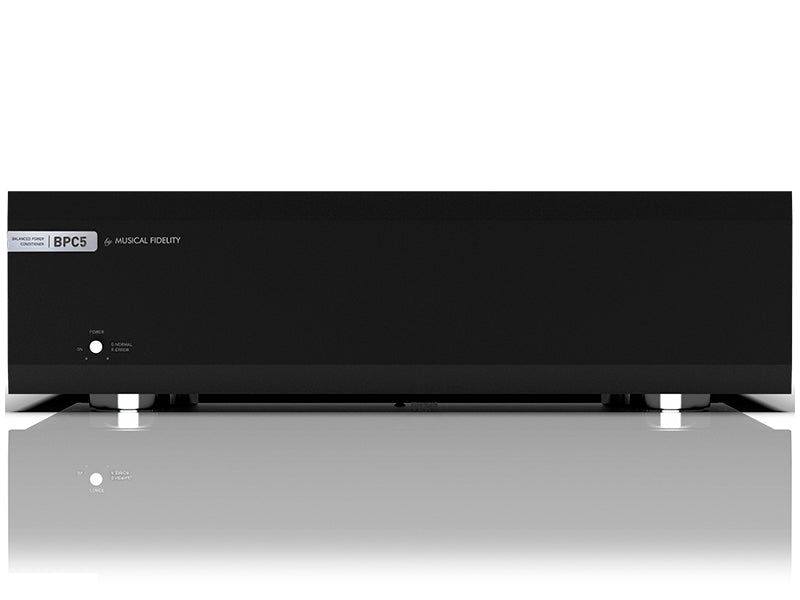
BPC5 is a 5 A balanced mains conditioner with 4 outlets across 2 isolated zones.
BPC5 is sized for a substantial integrated amplifier plus a separate source. It provides 4 outlets across 2 isolated zones and a maximum total current of 5 A, allocated as one 1.000 VA and one 200 VA . Its 1.200 VA balanced toroidal transformer reduces common-mode noise and separates outlet groups; overload and surge protection operate without fuses in the ground path. Selection starts with actual consumption rather than socket count.
Key features
- 1,000 VA main bank
- 200 VA source bank
- Four outlets and 5 A total
- 1,200 VA toroid
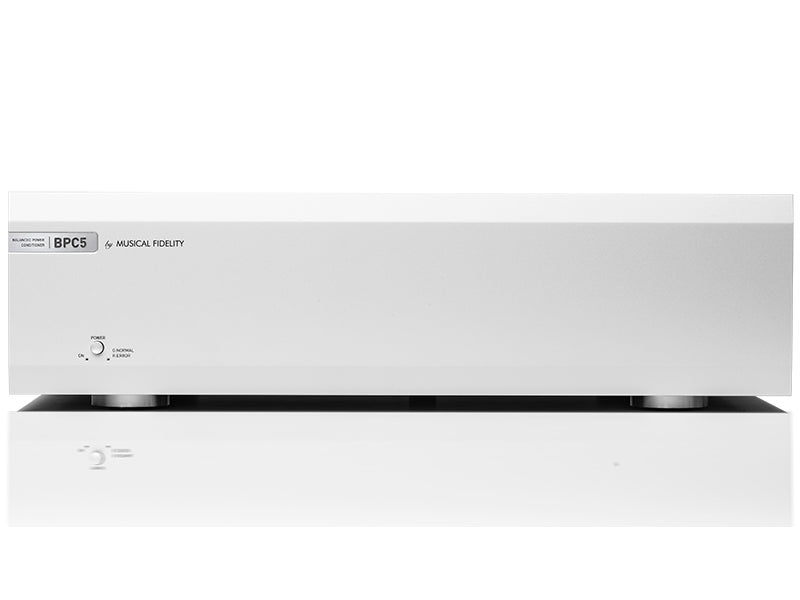
- Black or silver finish
Built around an integrated amplifier
BPC5 organises typical stereo with one amplifier and one or two sources. The 1,000 VA branch accepts the product creating current peaks; the 200 VA branch reserves a separate environment for streamer, player or phono stage without wasting large capacity on tiny loads.
Deliberately unequal allocation
The groups are not interchangeable. Putting amplification on the small bank restricts margin, while using 1,000 VA only for sources wastes the hierarchy. Cable labels prevent errors when the rack changes.
The conventional lounge model
Five amps cover a serious yet straightforward system. Owners of high-current pre/power electronics, more sources and video move to BPC10; users treating only DAC and preamp can stay with BPC3. BPC5 sits between front-end conditioning and a separate installation.
Twenty kilograms need support
The transformer brings weight to 20.6 kg and demands a rigid shelf. Distance from the turntable and free air prevent an electrical benefit becoming vibration or magnetic coupling near the cartridge.
Everyday protection
Overload and surge monitoring provides a barrier for connected electronics, but never makes a compliant household installation optional. After major storms or electrical work, operation and connections deserve inspection. Its advantage over BPC3 is not another set of four sockets, but the ability to reserve nearly all capacity for an amplifier while keeping the source on a separate group. That asymmetry defines its role. For BPC5, dimensions, weight, ventilation, connections and system capacity should be checked as one project, leaving operating margin instead of using every specification at its limit. A trial in the actual chain remains more useful than conclusions drawn from one technical figure. Consider a lounge with integrated amplifier, streamer and television: amplification uses the 1,000 VA bank while the 200 VA group separates low-draw digital devices. This is not the model for two monoblocks; it organises a conventional stereo system built around one power-hungry component.