A converter that brings order to every digital source
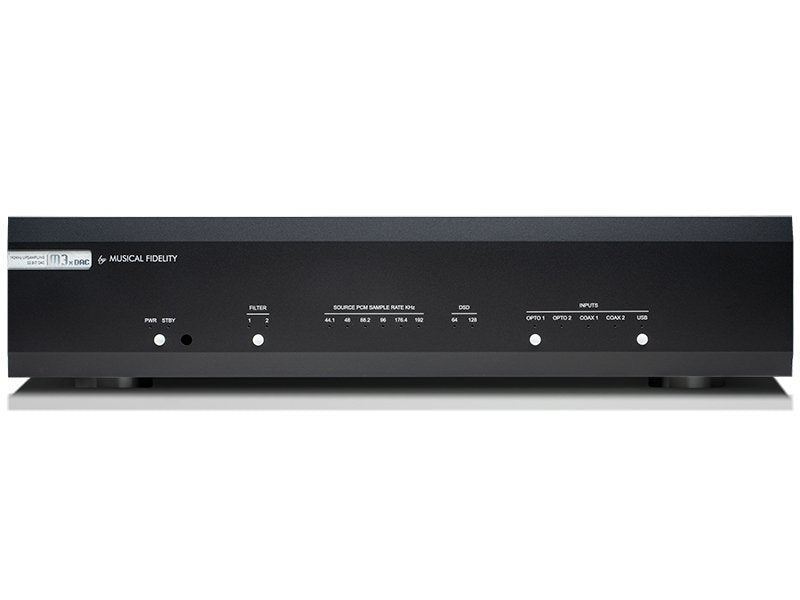
M3x DAC converts PCM up to 32-bit/192kHz and DSD256, with upsampling, selectable filters and RCA/XLR outputs.
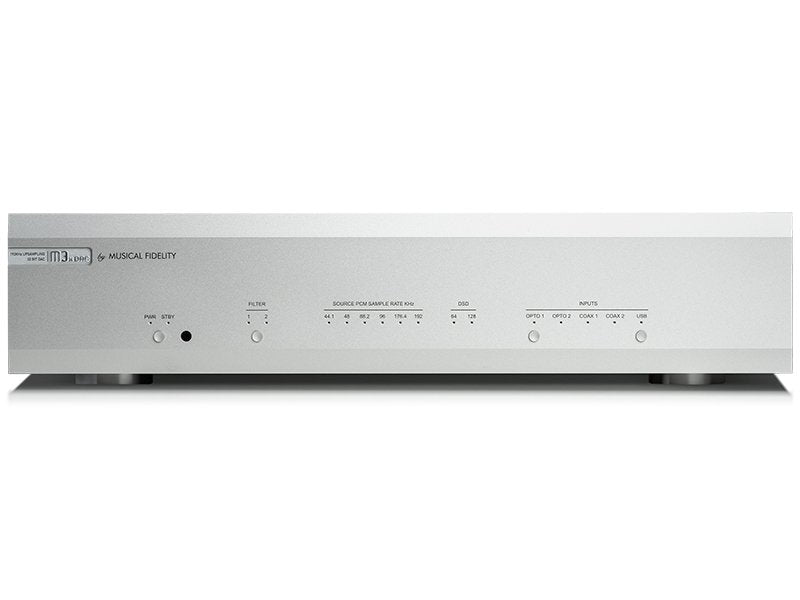
M3x DAC serves a system that already has analogue amplification but receives music from a computer, streamer, transport and television. Two optical, two coaxial and one USB-B input gather those sources in a single converter; RCA and XLR outputs connect it to integrated amplifiers or preamplifiers. It is not a network player and stores no music: its role is reconstructing the analogue signal and maintaining consistent quality across different digital devices.
Key features
- Texas Instruments PCM1795 32-bit/192kHz DAC
- PCM upsampling to 192kHz through SRC4392
- Native and DoP playback up to DSD256
- Two PCM digital filters and two DSD analogue filters
- Two optical, two coaxial and one USB-B input
- RCA and balanced XLR analogue outputs
Upsampling and reclocking are separate tasks
The SRC4392 receives PCM signals, resamples them to 192kHz and rebuilds their timing reference before the PCM1795. The purpose is not to invent information beyond the file, but to present the DAC with a consistent stream and reduce errors tied to the source clock. DSD files instead follow a native or DoP path up to DSD256 without entering the same PCM process.
Filters as a system-tuning tool
Two digital filters for PCM and two analogue filters for DSD allow impulse and high-frequency behaviour to be selected for the system. Differences may be subtle and depend on recording, loudspeakers and room; no setting is universally correct. The option has value because it permits a controlled comparison without external equalisers or additional processing.
RCA or XLR according to the rest of the system
Single-ended and balanced outputs have dedicated buffers. XLR is useful with a balanced preamplifier or long cables, where noise rejection can offer an advantage; RCA remains correct for most integrated amplifiers. A toroidal transformer separates M3x DAC from small USB-powered dongles: conversion and output stage are engineered here as a stable hi-fi source.