Conversion, digital preamplifier and balanced headphones in M8 architecture
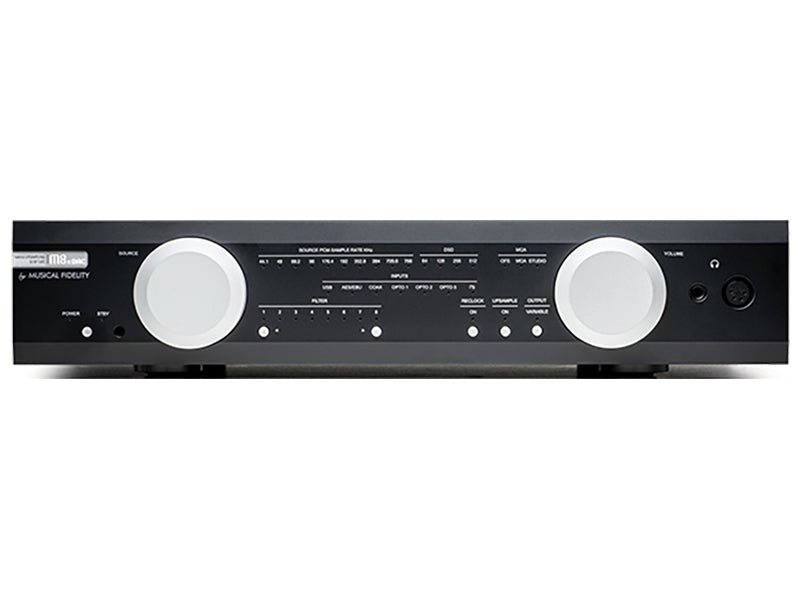
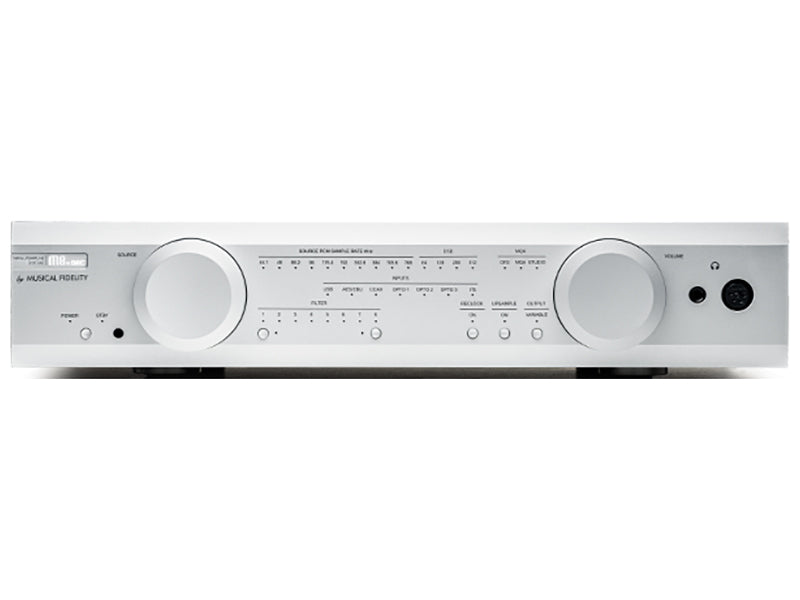
M8x DAC uses two ES9038Q2M chips, a balanced discrete output stage, HDMI I2S and balanced headphone drive for reference digital systems.
M8x DAC takes the M6 dual-Sabre platform into a more ambitious analogue architecture. Two ES9038Q2M chips work in dual differential mode under a 16-core Altera processor; the output stage is fully discrete and balanced. USB-B, AES/EBU, optical, coaxial and HDMI I2S cover different transports. RCA and XLR can be fixed or variable, while the balanced headphone output has its own discrete Class A/B power stage.
Key features
- Two ESS ES9038Q2M, 32/768 PCM, MQA and DSD512
- 16-core Altera MAX II processor
- Fully discrete balanced analogue output stage
- Three optical, coaxial, AES/EBU, USB-B and HDMI I2S
- Fixed or variable RCA/XLR outputs
- Discrete balanced Class A/B headphone output
The analogue stage defines the M8 step
The DAC chip ends digital processing, but the signal still needs filtering, buffering and delivery to the preamplifier. M8x uses discrete parts and a balanced path rather than generic integrated output circuits. Its encapsulated transformer reduces radiation and supplies a more demanding section. The step from M6x is chiefly about what happens after conversion.
HDMI I2S for compatible transports
I2S separates data, clock and word selection instead of recombining them into one S/PDIF stream. The HDMI socket only provides a physical connector and does not accept ARC television audio. As I2S pin assignments are not universal, transport compatibility must be checked. AES/EBU, coaxial, optical and USB remain reliable alternatives.
Direct to power amplifiers or through a preamplifier
Variable output can feed M8s 500S or two 700M units in a digital-only system. With vinyl and analogue sources, M8s PRE remains necessary and the DAC should use fixed output. Clear separation between modes avoids duplicated volume controls or uncontrolled levels. Source requirements, not desired box count, decide the route.
Balanced headphones as a second system
The fully discrete headphone stage handles a balanced connection and has more substantial power than an accessory socket. DAC and sources can be shared with the loudspeaker system while maintaining high-level personal listening. Headphone impedance and sensitivity still matter; balanced does not automatically suit every model.
Formats and filters do not replace source quality
32/768 PCM, MQA and DSD512 describe accepted streams. They do not repair poor files or require prior conversion. Transport quality, clocking and software configuration remain relevant. M8x DAC is worthwhile when many digital sources must converge and the system can exploit XLR, discrete output and balanced headphones.