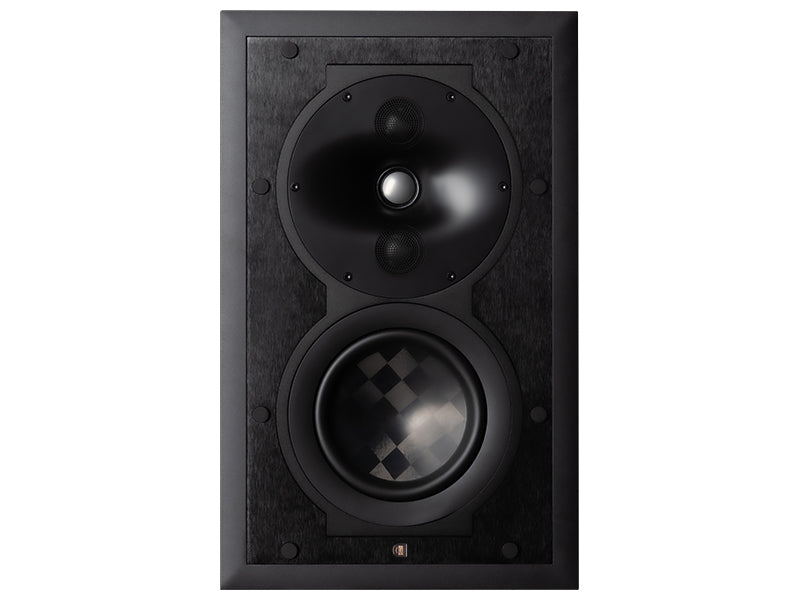
S4i-LCRS: one Signature model for left, centre, right or surround
The reason for the S4i-LCRS is versatility: one compact format can build a coherent in-wall system across several channel roles.
It can operate as left, centre, right or surround, vertically or in the orientation required by the design. One woofer reduces size from the S5i models, while the Signature DPC Array retains Beryllium and Textreme TPCD where tonal consistency and coverage matter more than maximum output.
Key features
- 3-way in-wall loudspeaker
- DPC Array with Beryllium and Textreme TPCD
- 180 mm Textreme TPCD woofer
- 50-250 W; 4 ohms; 88 dB
- 438 x 257 x 101.7 mm cut-out; 11.2 kg
- THX Ultra LCR and THX Dominus Surround
Three roles, one opening
In a structurally constrained room, repeating the same 438 x 257 mm opening simplifies framing, wiring and replacement. Three S4i-LCRS units can form the front stage and further units can act as side or rear channels. This modularity matters more than one power figure and maintains the same sonic imprint around the listener.
When to use it as LCR
As a front channel it suits small or medium rooms with dedicated subwoofers. Compared with the S5i-LR/C it loses one woofer and sensitivity, so it is not the choice for long distances or extreme levels. It instead fits broken wall layouts, niches or screen edges where a 665 mm body could not be installed.
When to use it as surround
THX Dominus Surround certification underlines the design's second talent. Controlled dispersion creates a precise lateral field without changing material from Signature front speakers. At the correct height and angle it makes front-to-back movement continuous; it should not be confused with the S3ic, which is designed for ceiling and height channels.
Signature construction in a smaller format
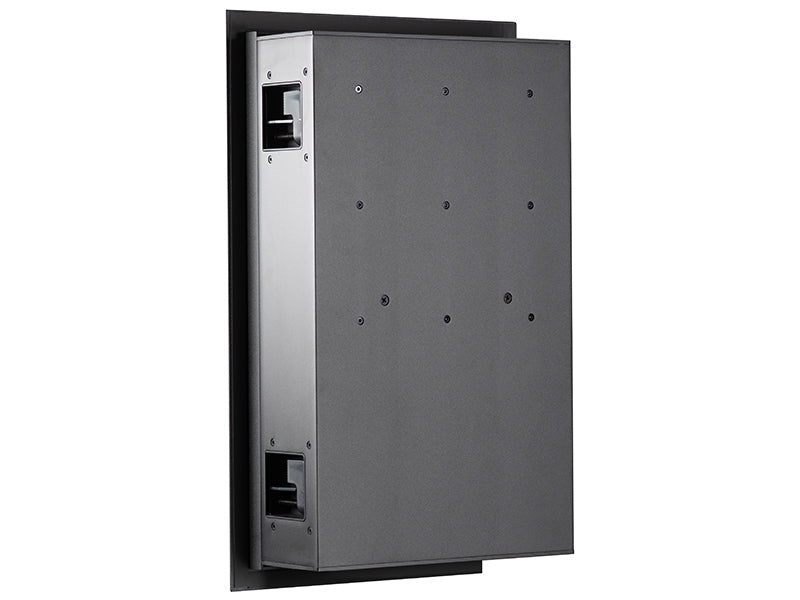
Beryllium, Textreme TPCD and the DPC Array retain the S hierarchy over the silk- and HPF-based R4i-LCRS. Sealed back box, quick dogs and paintable magnetic grille follow the common in-wall platform. The choice between S4i and R4i therefore follows continuity with the system and intended quality level, not the opening alone.