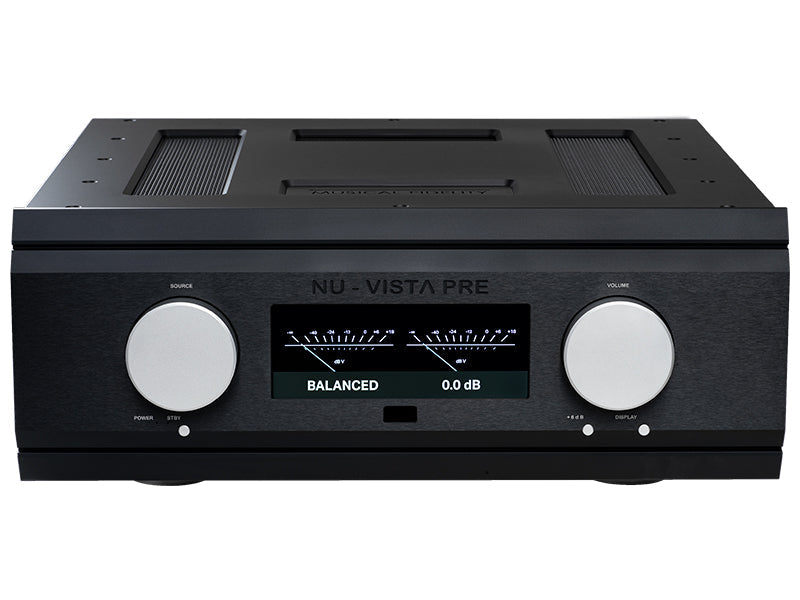
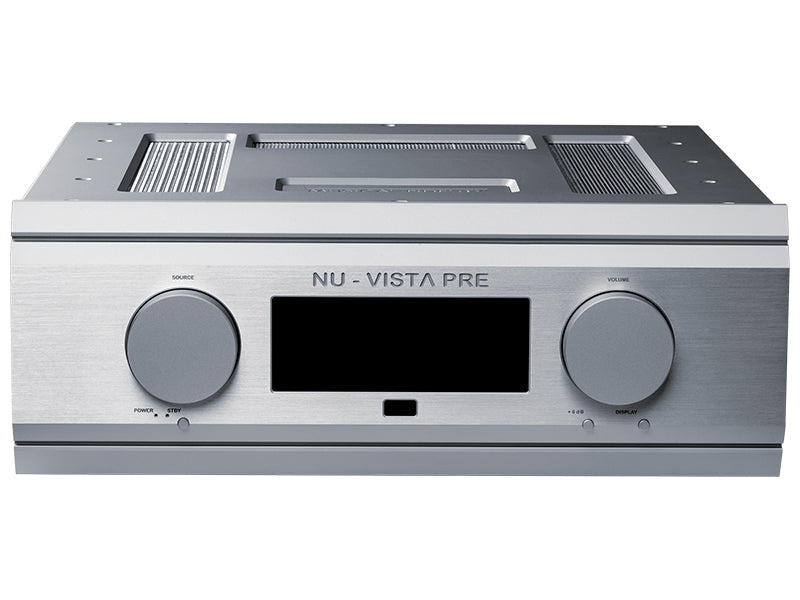
Twelve sources and two chassis at the centre of the system
Nu-Vista PRE is a balanced dual-mono preamplifier with separate supply and twelve line inputs.
Nu-Vista PRE separates control and power supply into two chassis to become the centre of a reference chain. Six RCA and six XLR inputs accept twelve analogue sources, while fixed and variable outputs on both formats serve power amplifiers, recording and parallel systems. Eight 6S51N Nuvistors form balanced buffers and the output stages operate in pure Class A. It cannot drive loudspeakers: PAS, two PAM units or another compatible power amplifier are required.
Key features
- Two-chassis preamplifier
- Six RCA and six XLR inputs
- Eight Nuvistors in balanced buffers
- Fixed and variable RCA/XLR outputs
- Trigger in/out and remote control
Why twelve inputs
DAC, phono stage, tuner, recorder and professional sources can remain connected without external switching. XLR suits long runs and balanced equipment; RCA maintains broad compatibility. The quantity has value only in a genuinely elaborate system.
Power outside the audio chassis
The second case moves transformers and mains current away from low-level signals. Pre and supply weigh 22 and 25 kg respectively; they are not casual stacking accessories and need checked load capacity, ventilation and rack layout.
PAS or two PAM units
PAS supplies two 300 W channels with one audio amplifier and its external supply. A pair of PAM units assigns 600 W and two chassis to each channel, requiring four boxes for power alone. PRE controls either architecture.
Class A where it matters
The Class A output stage drives cables and amplifier inputs, not loudspeakers. Low power demand allows linearity to take priority, while the power amplifier provides current. Trigger in/out coordinates an otherwise complex system.
Intended owner
It makes sense when sources and power stages already match its level and each block should remain independently upgradeable. 800.2 combines control and power to save space. PRE buys flexibility and isolation rather than economical convenience. Complexity pays only with a clear map of sources, outputs and triggers. Labels, balanced wiring and power sequence should be designed together: a reference preamplifier must simplify daily use rather than make it fragile. For Nu-Vista PRE, dimensions, weight, ventilation, connections and system capacity should be checked as one project, leaving operating margin instead of using every specification at its limit. A trial in the actual chain remains more useful than conclusions drawn from one technical figure.